

It’s easy to assume wristwatches have always existed, seamlessly blending style and function. Yet the concept of wearing a timepiece on the wrist is surprisingly modern. For centuries, men relied on pocket watches as symbols of status and precision, while women, restricted by fashion, wore timepieces as pendants or decorative accessories.
Everything changed in the early 19th century when a visionary watchmaker crafted something entirely new for a queen: a timepiece designed to be worn on the wrist. This creation, made for Queen Caroline Murat of Naples in 1810 by Abraham Louis Breguet, is widely regarded as the world’s first wristwatch.
What began as a royal experiment soon evolved into one of the greatest innovations in horology. From this elegant beginning emerged a revolution that would reshape how humanity interacted with time, spanning from delicate jewelry for women to indispensable instruments for aviators and soldiers and, ultimately, to timeless symbols of identity and craftsmanship.
The First Wristwatch: Breguet and the Queen of Naples (1810)

Abraham-Louis Breguet was one of the greatest watchmakers of all time. Born in 1747 in Neuchâtel, Switzerland, he moved to Paris and quickly became known for his genius craftsmanship. Breguet was responsible for several groundbreaking inventions, including the tourbillon, the self-winding movement, and the gong-sounding repeater. His clients included royalty, aristocrats, and even Napoleon Bonaparte himself.
Among them was Queen Caroline Murat of Naples, Napoleon’s younger sister. Known for her taste in luxury and art, Queen Caroline commissioned a special timepiece from Breguet in 1810. She did not want another pendant or brooch watch. She wanted something that could be worn on her wrist.
This was something entirely new. No one had ever designed a watch specifically to be worn this way.
Breguet got to work, creating a masterpiece that would later be recorded as Breguet No. 2639. It was oval in shape, with a silver dial and elegant curved numerals. Inside, it housed a repeater mechanism, a feature that could chime the hours and minutes on demand, a highly complex feature for the time. The watch was attached to a wristlet made of golden threads and strands of hair, a combination that was both fashionable and personal.
In 1812, the finished watch was delivered to Queen Caroline. This was, by all available records, the first watch ever made specifically for the wrist. The original timepiece is now lost, but historical documents survive, including one noting its repair in 1855, decades before any other known wristwatch existed. Modern Breguet honors this legacy through its Reine de Naples collection, which still carries the same oval design that once adorned the Queen’s wrist.
The Debate: Who Really Made the First Wristwatch?
 Of course, as with many “firsts” in history, there’s some debate. Some point to Patek Philippe, another Swiss watchmaker, as the true creator of the first wristwatch.
In 1868, Patek Philippe made a gold wristwatch for Countess Koscowicz of Hungary. The watch was beautifully ornate, covered in engravings and jewels. This piece has survived the centuries and is now displayed at the Patek Philippe Museum in Geneva, giving it a visible, tangible legacy. This is why Guinness World Records credits Patek Philippe with making the first wristwatch.
However, most historians side with Breguet. His detailed records show the Queen of Naples’ commission from 1810, and the follow up repair more than forty years later. The key difference lies in the details: Patek Philippe’s 1868 piece was the first Swiss wristwatch, while Breguet’s was the first wristwatch ever made, crafted in France decades earlier. So, while Patek Philippe’s creation is physically preserved, Breguet’s innovation came first, a subtle but crucial distinction in the story of time.
The First Wristwatches Were Made for Women
Through the 1800s, wristwatches became a favorite among women of high society. Watchmakers across Europe began producing jeweled, delicate timepieces for ladies. These weren’t just tools to tell time; they were intricate pieces of art meant to match gowns, tiaras, and jewels, solidifying their status as an ornamental accessory.
Men, however, had a very different view. Wristwatches were seen as decorative and “feminine.” The idea of a man wearing one was almost laughable in polite society. For them, a sturdy pocket watch, which required a specific, deliberate action to check, was the true mark of seriousness and sophistication. This cultural divide continued until the early 1900s, when one problem in the skies changed everything.
The First Men’s Wristwatch: Cartier and Alberto Santos-Dumont (1904)

By the start of the 20th century, airplanes were becoming a new fascination. Among the pioneers of early aviation was Alberto Santos-Dumont, a Brazilian born inventor and pilot who lived in Paris. He became famous for flying airships and early airplanes across the city and for his stylish personality.
Santos-Dumont had a practical problem that endangered his flying: he needed to check the time constantly during flights to measure performance and track records, but pulling out a pocket watch was dangerous and inconvenient, as it required taking one hand off the controls.
He mentioned this to his friend Louis Cartier, the head of the famous Parisian jewelry and watch house. Cartier decided to create something entirely new for him, a watch designed to be worn securely on the wrist.
In 1904, Cartier presented Santos-Dumont with his custom wristwatch. It was square shaped, mounted on a strong leather strap, and featured visible screws around the bezel, a bold, industrial look that reflected the mechanical spirit of aviation. It was elegant yet rugged, blending style and function perfectly.
Santos-Dumont wore the watch on all his flights, including the historic 14-bis flight in 1906, where he set a world record for flight speed. Photos of the moment, clearly showing him wearing the watch, inspired a generation of men who admired his courage and charm. In 1911, Cartier released the Cartier Santos-Dumont for public sale. It became the first wristwatch ever marketed to men. What was once considered “feminine” suddenly became a symbol of adventure, modernity, and progress.
War Changes Everything: The Rise of the Wristwatch (1914–1918)
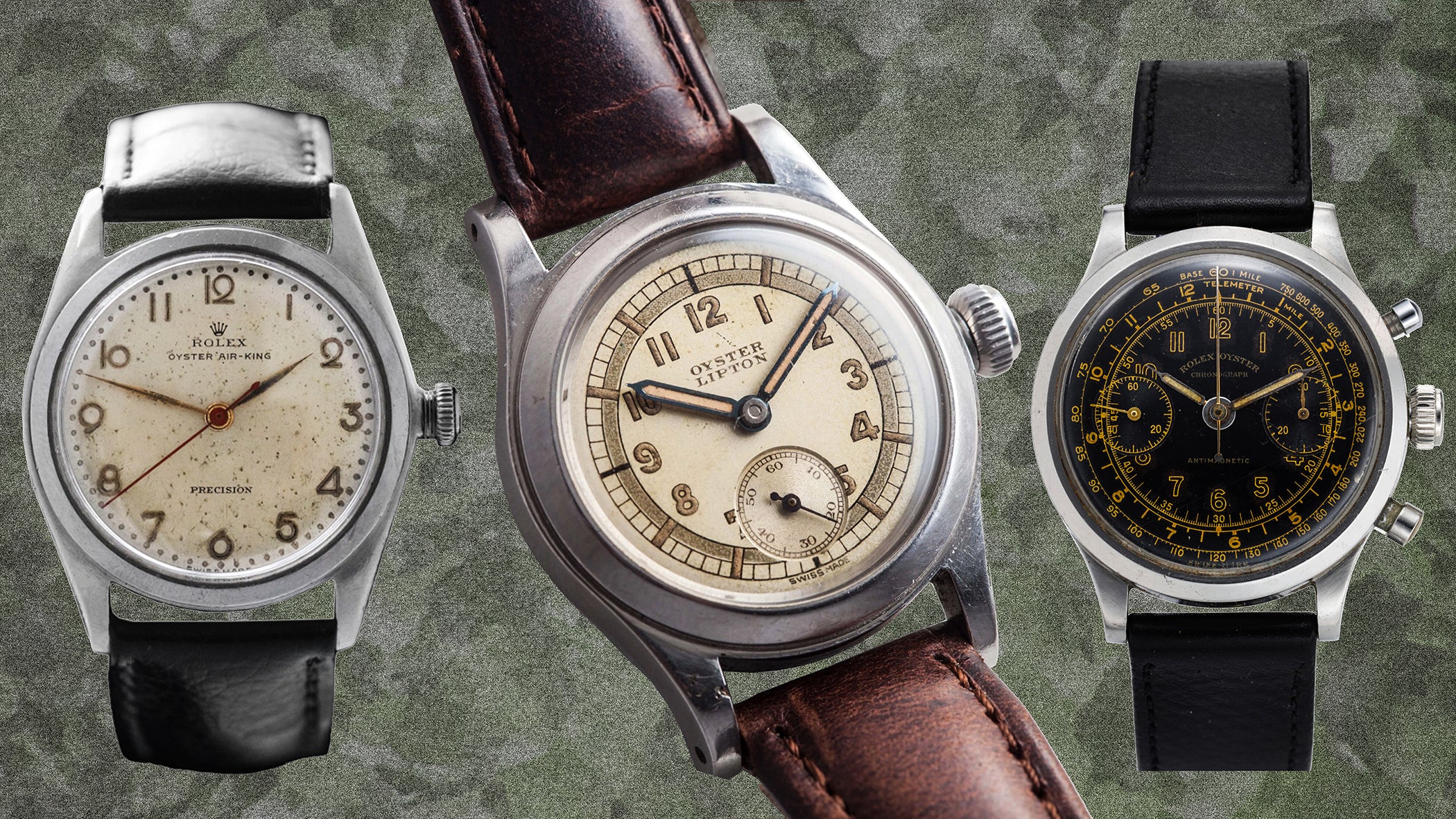 While Santos-Dumont helped make wristwatches fashionable, another event would make them essential: World War I.
Soldiers on the front lines desperately needed reliable timepieces for coordinating attacks, communicating troop movements, and timing artillery fire. Pocket watches were completely impractical: fumbling with one while handling a weapon could mean the difference between life and death.
To solve this, soldiers began modifying their pocket watches by soldering small wire loops onto the cases and attaching leather straps. These makeshift wristwatches were sturdy, easy to read, and quick to access. They became known as “trench watches.”
Soon, watchmakers began producing purpose built military wristwatches with rugged cases, luminous dials for night visibility, and protective grids over the glass to prevent damage. This was the first mass production of specialized wristwatches.
When the war ended, soldiers brought their wristwatches home. They had seen firsthand how practical these timepieces were, and they continued to wear them in civilian life. The once “unmanly” wristwatch now represented bravery, practicality, and survival. By the early 1920s, the pocket watch had all but disappeared from daily life. The wristwatch had taken its place, not just as a tool, but as a mark of modern identity.
The Evolution After the War
Once wristwatches became mainstream, innovation took off at an incredible pace. Watchmakers experimented with new materials and features to meet the demands of an active, modern world.
-
Rolex introduced the Oyster in 1926, the first truly waterproof wristwatch, protecting the delicate inner workings from dust and water.
-
Longines and Omega created watches for explorers, racers, and divers, designing for specific, rugged environments.
-
Chronographs, or stopwatches, became popular, allowing users to time races or technical processes with precision.
-
Automatic Winding was perfected, eliminating the need to manually wind the watch every day.
By the mid 20th century, the wristwatch had become more than a timekeeper; it was a reflection of lifestyle. Whether you were a pilot, a businessman, or a sportsman, there was a specialized wristwatch that suited your world and reflected your ambition.
Why the First Wristwatch Still Matters
 The story of the first wristwatch isn’t just about gears, gold, or glass; it’s about how people cleverly adapt technology to their lives.
A queen’s need for convenience, a pilot’s need for practicality, and soldiers’ need for survival all shaped what we wear on our wrists today. Each stage of the wristwatch’s evolution reflects human creativity and the deep desire to make life a little easier, and a little more beautiful.
From Breguet’s royal creation in 1810, to Cartier’s pilot’s watch in 1904, to the soldiers of World War I, the wristwatch’s journey is a timeless reminder that innovation often begins with a simple need and an idea that dares to challenge tradition. The next time you glance at your wrist, remember: you’re wearing two centuries of history, invention, and human story, all ticking quietly beneath a piece of glass.
Your Next Classic Awaits

The greatest watches are those that perfectly blend history, function, and enduring style. The Argos Olympus embodies this tradition, built with the reliability and clarity that today’s world demands, yet designed with the timeless elegance of the pioneers. It's not just a watch; it's the next classic in your story.
Discover the Argos Olympus and secure a timepiece built for the long run.


